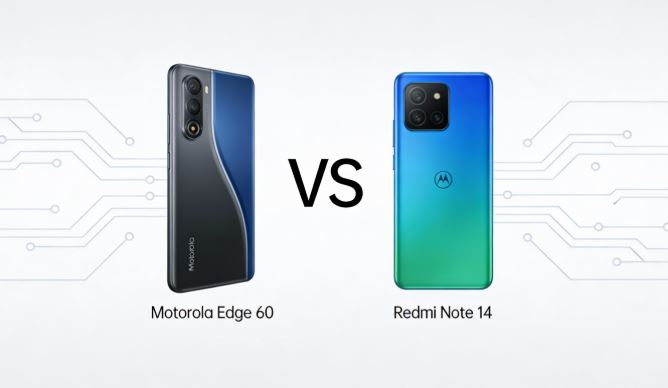
Choosing between the Motorola Edge 60 and Redmi Note 14 Pro 5G can be challenging since both devices launched in early 2025 as compelling mid-range options with similar pricing. While they share the same processor and display size, key differences in camera systems, battery capacity, and software experience set them apart.
Design & Build Quality
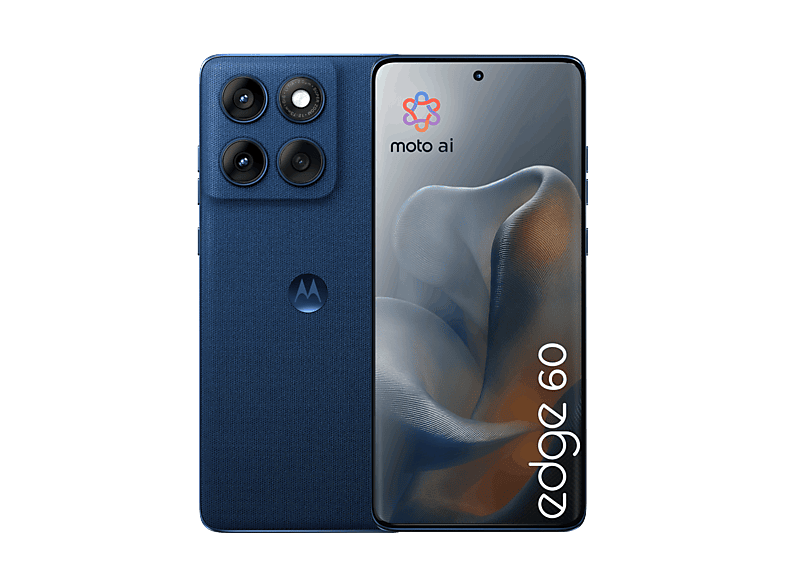
The Motorola Edge 60 features a sleek, lightweight design weighing just 179-181g with dimensions of 161.2 x 73.1 x 7.9mm. It boasts a premium quad-curved display with Gorilla Glass 7i protection on the front, though the back is plastic. Motorola goes further with IP68/IP69 dust and water resistance plus MIL-STD-810H military-grade certification, making it one of the most durable phones in this segment.
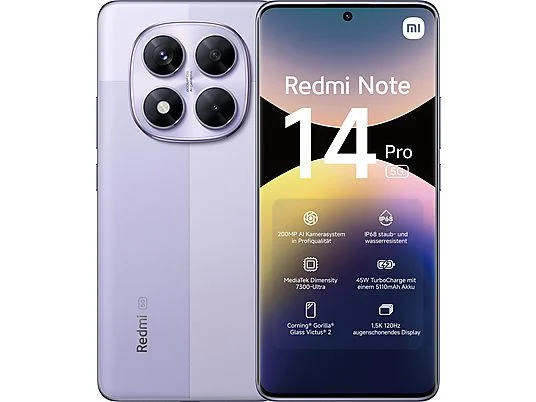
The Redmi Note 14 Pro 5G is slightly heavier at 190g and thicker at 8.4mm (162.3 x 74.4 x 8.4mm). It features Gorilla Glass Victus 2 on the front (stronger than the Edge 60’s glass) with options for plastic or eco-leather backs. Water resistance is rated at IP68 only, without the high-pressure water jet protection of the Edge 60’s IP69 rating.
Both phones offer excellent build quality, but the Motorola Edge 60 edges ahead with superior ruggedness certifications.
Display Technology
This is where both phones are remarkably similar yet subtly different. Both feature 6.67-inch displays with identical 1220 x 2712 pixel resolution (446 ppi) and 120Hz refresh rates.
The Motorola Edge 60 uses a P-OLED panel with HDR10+ support and an impressive 4500 nits peak brightness. GSMArena’s testing measured actual brightness at 1401 nits, which is excellent for outdoor visibility. The display supports 720Hz PWM dimming to reduce eye strain.
The Redmi Note 14 Pro features an AMOLED screen (68 billion colors) with 3000 nits peak brightness and support for both HDR10+ and Dolby Vision. Measured brightness reached 1138 nits in testing, which is slightly lower than the Edge 60 but still very good. It uses 1920Hz PWM dimming for even better flicker reduction.
Winner: Motorola Edge 60 for superior real-world brightness, though the Redmi Note 14 Pro adds Dolby Vision support.
Performance & Software
Both phones run the same chipset globally: the MediaTek Dimensity 7300 (4nm process) with octa-core CPU and Mali-G615 MC2 GPU. The India version of the Edge 60 gets the slightly faster Dimensity 7400. Performance is nearly identical in benchmarks:
- Motorola Edge 60: AnTuTu 661,808 / GeekBench 2,999
- Redmi Note 14 Pro: AnTuTu 684,320 / GeekBench 2,913
Memory configurations differ: the Edge 60 offers up to 12GB RAM with 512GB storage, while the Redmi Note 14 Pro matches this but lacks microSD expansion that the Edge 60 provides. Both use UFS 2.2 storage.
Software is where experiences diverge significantly:
- Motorola Edge 60: Ships with Android 15 out of the box with a clean, near-stock experience and promises 3 major OS updates
- Redmi Note 14 Pro: Launches with Android 14 and Xiaomi’s HyperOS, also with 3 major updates promised
The Motorola offers a cleaner interface with less bloatware, while Xiaomi provides more customization options through HyperOS.
Camera Systems: The Big Differentiator
This is where the two phones take completely different approaches.
Motorola Edge 60 Camera Setup
The Edge 60 focuses on versatility with a triple camera system:
- 50MP main camera (f/1.8, 1/1.56″, OIS)
- 10MP telephoto (f/2.0, 3x optical zoom, OIS)
- 50MP ultrawide (f/2.0, 122°, PDAF)
- 50MP selfie camera (4K video capable)
The standout feature here is the dedicated 3x optical zoom telephoto lens with OIS, a rarity in this price range. Video recording maxes out at 4K@30fps with excellent stabilization.
Redmi Note 14 Pro Camera Setup
Xiaomi takes the megapixel race seriously with:
- 200MP main camera (f/1.7, 1/1.4″, OIS) – significantly larger sensor
- 8MP ultrawide (f/2.2, 120°)
- 2MP macro
- 20MP selfie camera
The massive 200MP sensor theoretically captures more detail and performs better in low light thanks to its larger 1/1.4″ size. However, it lacks a telephoto lens, meaning digital zoom only.
Winner: Depends on your needs. The Motorola Edge 60 wins for zoom capabilities and overall versatility, while the Redmi Note 14 Pro excels in main camera resolution and low-light performance.
Battery Life & Charging
The Redmi Note 14 Pro takes a decisive victory here with its 5110mAh battery compared to the Edge 60’s 5200mAh (or 5500mAh in China/India markets). Despite similar capacities, battery endurance differs:
- Motorola Edge 60: 58 hours 54 minutes endurance rating
- Redmi Note 14 Pro: 40 hours 51 minutes endurance rating
The Edge 60 unexpectedly delivers superior battery life despite running a brighter display. However, charging is where they differ:
The Motorola charges significantly faster, reaching full charge in less time.
Audio & Multimedia
Both phones feature stereo speakers with Dolby Atmos support and no 3.5mm headphone jack. Audio testing shows:
The Edge 60 delivers louder, clearer audio output. The Redmi adds 24-bit/192kHz Hi-Res audio support and an infrared blaster for controlling appliances, features absent on the Motorola.
Connectivity & Features
Both support 5G, WiFi 6, NFC, Bluetooth, and USB-C. The Redmi Note 14 Pro uses newer Bluetooth 5.4 versus unspecified version on the Edge 60.
Unique to Redmi: IR blaster for universal remote functionality.
Unique to Motorola: microSD card slot for storage expansion and Smart Connect ecosystem features.
Pricing & Value Proposition
This is where the comparison gets interesting:
- Motorola Edge 60: £299.99 / €268.69 (512GB/12GB model)
- Redmi Note 14 Pro: $295.99 / £218.00 / €221.99 (256GB/8GB), up to €349.95 for 512GB/12GB
The Redmi Note 14 Pro offers slightly better value at entry-level configurations, while the Motorola provides more storage for similar pricing at the high end.
Side-by-Side Specifications
Verdict: Which Should You Buy?
Choose the Motorola Edge 60 if you want:
- Superior durability (IP69 + military certification)
- Optical zoom telephoto camera
- Better battery endurance
- Faster 68W charging
- Lighter weight and cleaner Android experience
- Brighter display for outdoor use
- Storage expansion via microSD
Buy Motorola Edge 60 Here
Choose the Redmi Note 14 Pro if you want:
- 200MP main camera for maximum resolution
- Better value at entry-level pricing
- Stronger front glass (Victus 2)
- IR blaster for controlling appliances
- Dolby Vision display support
- HyperOS customization options
Buy Redmi Note 14 Pro Here
Both phones offer exceptional value in the mid-range segment with 5G connectivity, excellent displays, and solid performance. The Motorola Edge 60 is the better all-rounder with superior cameras, durability, and battery life, making it ideal for users who prioritize versatility and ruggedness. The Redmi Note 14 Pro appeals to photography enthusiasts who want maximum resolution and don’t mind sacrificing telephoto capabilities, plus those who value Xiaomi’s feature-rich software experience.